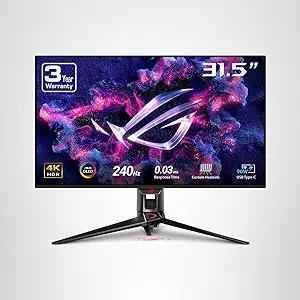
ASUS ROG Swift 32” 4K OLED Gaming Monitor (PG32UCDM) – UHD (3840 x 2160), QD-OLED, 240Hz, 0.03ms, G-SYNC Compatible, Custom Heatsink, Graphene Film, 99% DCI-P3, True 10-bit, 90W USB-C
Posted on by xasankaafi hussein
about this item
Key Specs & Features
- Panel & Size: 31.5″ (often rounded to “32-inch”) QD-OLED. @ROG+2Elara Online (www.elara.ie)+2
- Resolution: 4K / UHD — 3840 × 2160. B&H Photo Video
- Refresh Rate: 240 Hz. @ROG+1
- Response Time: 0.03 ms (GTG) — extremely fast for super responsive gaming. B&H Photo Video+1
- Contrast: Very high, thanks to OLED: 1,500,000 : 1 typical. @ROG
- Brightness: Typical ~450 nits, HDR peak up to ~1,000 nits. Royal Focus+1
- Color: 99% DCI-P3 color gamut, true 10-bit color. @ROG
- HDR: Supports HDR10. Also “True Black” HDR (VESA DisplayHDR 400 True Black) certification. Elara Online (www.elara.ie)+1
- Adaptive Sync: G-SYNC Compatible, FreeSync Premium Pro. Elara Online (www.elara.ie)
- Connectivity:
- 1 × DisplayPort 1.4 (with DSC) B&H Photo Video
- 2 × HDMI 2.1 EEZEPC
- 1 × USB-C (with DisplayPort Alt Mode) + 90 W Power Delivery. @ROG
- USB hub (USB-A) for peripherals. B&H Photo Video
- Design / Build:
- Custom passive heatsink + graphene film to help manage heat — helps reduce risk of OLED burn-in. @ROG
- Ergonomics: Height adjustable, tilt, swivel. Accelerator
- VESA mount: 100 × 100 mm. Accelerator
- Warranty / Care: Has ASUS OLED Care system (software) to help mitigate burn-in risks. @ROG
- Power:
- Typical power consumption: ~42 W. Accelerator
- Built-in security slot (Kensington). Accelerator
- Warranty: 3-year warranty is mentioned on the official site. @ROG
Strengths / Advantages
- Visual Quality: The QD-OLED panel gives very deep blacks, vivid colors, and high contrast, which is fantastic for both gaming and content — especially for dark scenes.
- Speed: 240 Hz + 0.03 ms response time makes this ideal for very fast-paced gaming (FPS, competitive).
- Future-Proof Inputs: With HDMI 2.1 and DisplayPort 1.4 (DSC), you can use high refresh rates at 4K.
- USB-C PD: The 90 W USB-C port allows you to power / charge a laptop while using the monitor, reducing cable clutter.
- Burn-in Mitigation: The combination of hardware (graphene film, heatsink) + software (OLED Care) lowers burn-in risk.
- Color Accuracy: With 99% DCI-P3 and true 10-bit, it’s also good for creative work (photo/video), not just gaming.
Trade-offs / Potential Drawbacks
- Price: Very premium. OLED gaming monitors at this spec level are expensive.
- Burn-in Risk: While mitigated, OLEDs inherently have some risk of burn-in with static UI elements, so usage habits matter.
- Power / Heat: OLED panels generate heat; good ventilation around the monitor is helpful.
- Brightness: While 1,000 nits peak is good, average brightness (450 nits) is not as high as some LCD HDR monitors — for very bright ambient rooms it may feel less bright.
- DSC Requirement: To hit 4K @ 240Hz via DisplayPort, it relies on DSC (Display Stream Compression), which some purists don’t like (though visual quality is very good with modern DSC).
Use Cases – Who This Is For
- Competitive gamers who want high FPS + very low input lag.
- Streamers / creators – the color fidelity (DCI-P3, 10-bit) makes it useful for creative work.
- Console gamers: With HDMI 2.1, good for next-gen consoles (PS5, Xbox Series X) if you want 4K high refresh.
- Laptop users: Especially those who want to use USB-C for both power & display.
Things to Check / Be Careful About When Buying
- Where will you buy it from — local vs international retailer? Importing may incur extra cost.
- Warranty coverage in your country / region — check that 3-year warranty applies locally.
- Whether your GPU or console supports 4K @ 240Hz over the input you plan to use.
- Cable quality: use high-quality DisplayPort / HDMI 2.1 cables to reliably get full performance.
- Monitor placement: because it’s 31.5″, make sure you have enough desk space and viewing distance.